Dallas Stars Acquire Tyler Myers: Filling a Crucial Defensive Gap with a Strategic Move
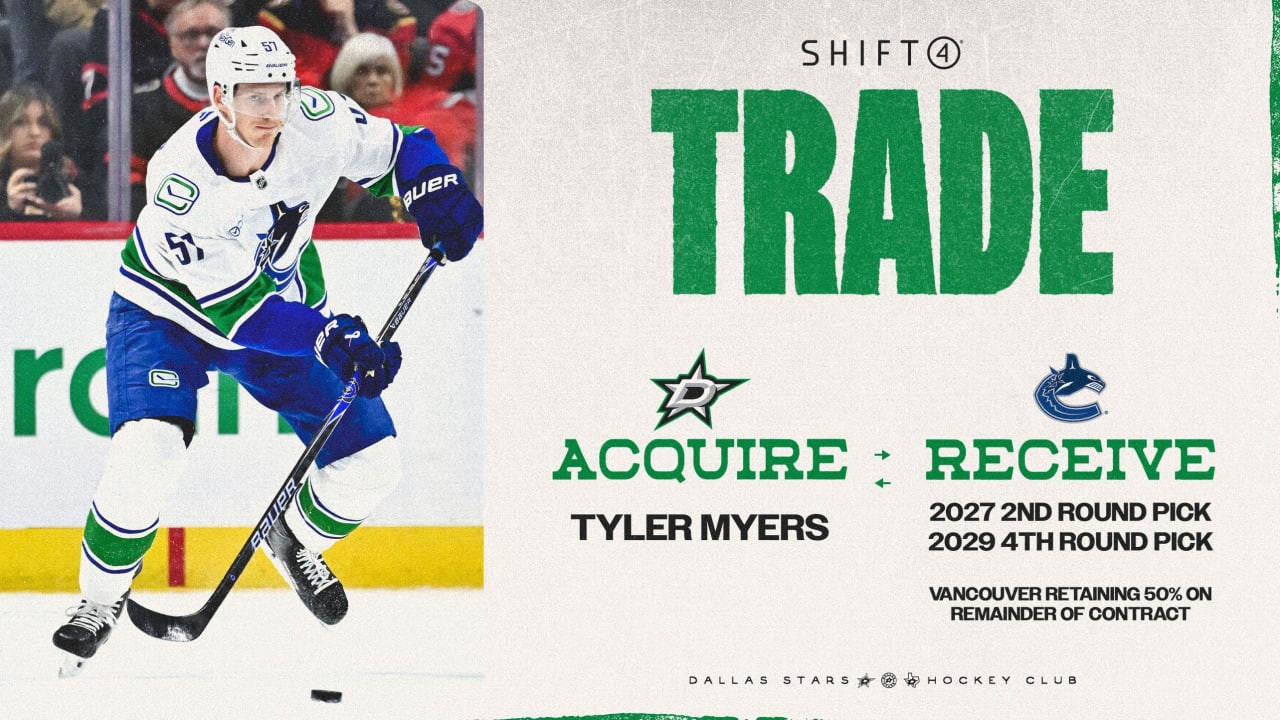
As the NHL trade deadline loomed, the Dallas Stars, known for their shrewd management and championship aspirations, made a significant splash that sent ripples across the league. In a move designed to fortify their blue line and counter rival acquisitions, the Stars officially acquired veteran defenseman Tyler Myers from the Vancouver Canucks. This strategic trade addresses a glaring need for right-shot defensive depth, providing a blend of experience, physicality, and a potentially high upside at an remarkably economical cost for the remainder of this season and next.
The acquisition of Myers is more than just adding another body to the roster; it's a testament to Dallas's meticulous approach to roster construction. With an eye on a deep playoff run, General Manager Jim Nill orchestrated a deal that brings in a seasoned pro without mortgaging the team's future, a delicate balance that often defines successful trade deadline strategies.
The Strategic Rationale Behind the Acquisition
The Stars' pursuit of a right-handed defenseman wasn't a secret; it was a pressing, obvious need. Despite recent efforts to bolster their defensive corps with additions like Chris Tanev in 2024 and Cody Ceci last year, the right side of the Dallas blue line still presented a noticeable vulnerability. Nils Lundkvist, while showing flashes of improvement and slowly earning trust from the coaching staff on the second pair alongside Thomas Harley, carries an inherent risk. His undersized frame and inconsistent defensive play have historically led to a short leash in the intense pressure cooker of the playoffs, making his long-term reliability a question mark.
Beyond Lundkvist, the Stars' right-side options were undeniably thin. Players like Ilya Lyubushkin and Alex Petrovic are marginal depth pieces, valuable in certain situations but not equipped to handle top-four minutes consistently, especially against playoff-caliber competition. This defensive void created a clear target for Dallas. The team needed a reliable, right-shot defender who could step into significant minutes if required, providing stability and a physical presence that could withstand the rigors of postseason play. Enter defenseman Tyler Myers, a player whose profile perfectly aligns with these specific requirements.
Unpacking the Deal: Cost-Effectiveness and Financial Prudence
The financial and asset management aspects of the Tyler Myers trade are perhaps as crucial as his on-ice contributions. The Stars sent a 2027 second-round pick and a 2029 fourth-rounder to the Vancouver Canucks, a modest price tag given Myers' potential impact. However, the true genius of the deal lies in its cap implications. Vancouver agreed to retain a significant half of Myers' $3 million salary, meaning the Dallas Stars acquire him at an incredibly palatable $1.5 million cap hit for both the remainder of the current season and the entirety of the next. This makes Myers an exceptional value proposition for two potential playoff runs.
This economical acquisition cost was not merely a stroke of luck; it was a necessity driven by Dallas's previous strategic maneuvers. The Stars had already expended considerable premium trade chips in prior transactions, most notably the Mikko Rantanen trade, which left them without first-round picks in 2026 and 2028. Furthermore, the team still needs to preserve assets and cap space to address other pressing needs upfront. Injuries to key forwards like Tyler Seguin, coupled with offseason departures such as Mikael Granlund, Mason Marchment, and Evgenii Dadonov, necessitated the flexibility to potentially add one or two top-nine forwards before the deadline. Blowing all their available assets on a big-name, expensive top-four defenseman simply wasn't a viable option.
In this context, Myers represents a masterful piece of asset management. He provides a significant upgrade over existing right-side options without crippling the team's future draft capital or salary cap flexibility. This prudent approach allows the Stars to continue their deadline shopping for offensive reinforcements while securing a much-needed defensive piece. For more insights into this clever strategy, read about how Dallas Stars' Smart Play: Tyler Myers Fills Right-Side Need.
Tyler Myers: A Deeper Dive into His Game and Potential Impact
At 36 years old and in his 17th NHL season, defenseman Tyler Myers brings a wealth of experience and a unique skill set to Dallas. Standing at an imposing 6-foot-6 and shooting right-handed, he is a physical specimen whose size and reach immediately stand out. Despite his large frame, Myers possesses above-average skating speed, making him a surprisingly mobile and rangy defender capable of covering a lot of ice. His enormous wingspan is a major asset, allowing him to break up plays, intercept passes, and maintain tight gaps.
Myers is renowned for his sturdy in-zone defensive play. He excels at winning battles along the boards, effectively stopping cycles down low, and is a willing shot-blocker. Crucially for a playoff-bound team, he knows how to box out opponents in front of the net, denying prime scoring opportunities – a skill that becomes paramount in tight-checking postseason games. While he has had a difficult season in Vancouver, with underlying numbers that look rough, many analysts suggest his struggles were largely "environmental." The Canucks were described as a "tire fire" with "zero semblance of structure," circumstances that often make even elite players look less effective. There's a strong expectation that Myers will bounce back significantly in a more stable and defensively structured environment like Dallas. He's arguably closer to a reliable No. 4 or No. 5 defenseman on a good team, rather than being "washed up."
However, Myers is not without his limitations. He can be prone to being overaggressive, leading to untimely penalties in the regular season. Yet, the narrative changes somewhat in the playoffs, where officiating often allows for more clutching and grabbing, a style that could inadvertently benefit Myers. His biggest challenge lies in his decision-making with the puck on zone exits. Under heavy forecheck pressure, he can struggle to navigate the puck effectively and may turn it over if forced into a high volume of breakout passes. The Stars' coaching staff will likely aim to simplify his role, leveraging his strengths while mitigating these puck-moving weaknesses.
The flexibility Myers offers is also a key benefit. Should Nils Lundkvist falter under playoff pressure or struggle with consistency, Myers provides a competent second-pair option alongside Thomas Harley. His veteran presence, combined with his physical style, could be precisely what the Stars need to withstand the grind of a long playoff run. The question remains: Can Tyler Myers Revive His Game with the Dallas Stars? All signs point to a system where he can thrive.
Beyond the Trade: Dallas Stars' Deadline Strategy and Outlook
The acquisition of defenseman Tyler Myers marks a foundational move for the Dallas Stars, but it's unlikely to be their last. By addressing the critical need for right-shot defensive depth in a cost-effective manner, General Manager Jim Nill has strategically positioned the team to make further enhancements. The fact that the Myers trade preserved significant assets and cap space underscores Dallas's broader deadline strategy: building a complete team capable of making a deep push for the Stanley Cup.
The Stars' ongoing need for "one or two top-nine forwards" remains a priority. With injuries to key players like Tyler Seguin and the departures of significant offensive contributors in the offseason, the team understands that championship aspirations require a balanced attack. The flexibility created by the Myers deal allows them to pursue these offensive targets without compromise, perhaps trading for a scoring winger or a versatile center who can provide secondary scoring and depth.
The outlook for the Dallas Stars is increasingly optimistic. They are firmly established as a contender, and these calculated moves at the trade deadline only reinforce that status. The addition of Myers provides much-needed insurance and a physical edge that will be invaluable in the playoffs. It signals a clear intent from the organization: they are all in. The Stars are not just looking to make the playoffs; they are meticulously crafting a roster designed to dominate when the stakes are highest, aiming for a long and successful postseason journey. Their balanced approach to strengthening both ends of the ice sets them up as one of the most formidable teams heading into the most exciting part of the NHL season.
In conclusion, the Dallas Stars' acquisition of defenseman Tyler Myers is a textbook example of smart, strategic team management. Addressing a crucial defensive gap with a cost-effective, experienced, and physically imposing player, the Stars have not only bolstered their blue line for two potential playoff runs but also retained the flexibility to make further impactful moves. Myers brings a unique blend of size, skating, and in-zone defensive prowess that is tailor-made for playoff hockey, and under the structured system of the Stars, he is poised to bounce back and be a significant contributor. This move solidifies Dallas's status as a legitimate Stanley Cup contender, setting the stage for an exhilarating remainder of the season and beyond.